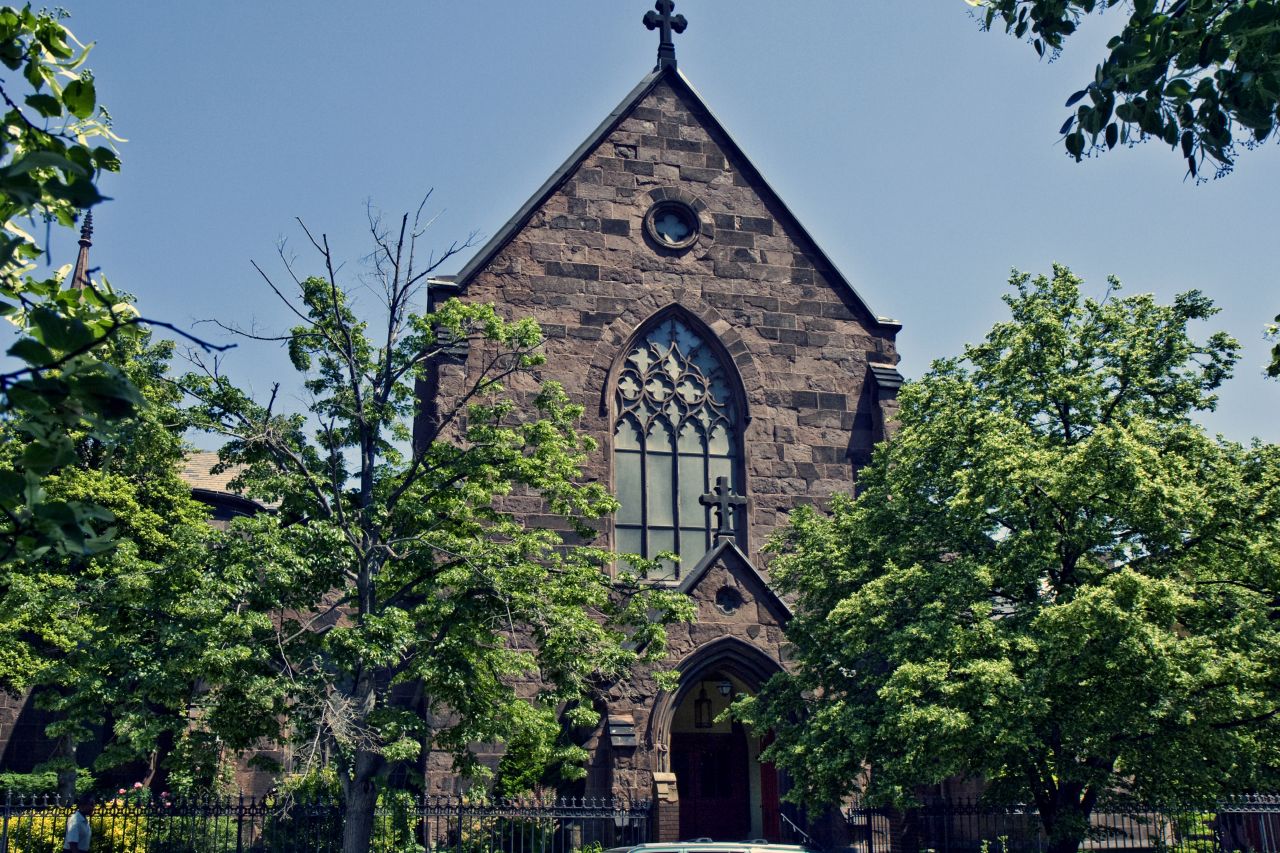
Incorporating elements of minimalism, film-score, and the rich tapestry of choral traditions, this setting of the Mass ordinary is a dramatic work that portrays Christ’s journey from crucifixion (“Kyrie Eleison”) to resurrection (“Agnus Dei”). Though this mass may be performed with the Kyrie omitted, it is most appropriately performed on Palm Sunday or another Sunday in Lent when the Kyrie, which depicts Christ’s triumphal entry into Jerusalem, can be performed. Written for the choir of Grace and St. Peter’s Church in Baltimore, Maryland, this piece received its world premiere on Sunday, February 11, 2024.
Movements
I. Kyrie Eleison
ABOUT THIS MOVEMENT
“Kyrie Eleison“—a stark portrayal of the crucifixion—begins in a manner inspired by Bach’s Mass in B-Minor and Arvo Pärt’s Passio. As the choir sings “Lord, have mercy” a 13-note ostinato in the organ part offers a constant reminder of human failings. “Christe Eleison” takes a dramatic tonal shift and travels to the gates of Jerusalem and Christ’s triumphant entry into the city on Palm Sunday. The subsequent repetitions of “Kyrie Eleison” maintain the core structure, but this time remain in the same key. This shift reflects a newfound knowledge of salvation through God’s grace—the 13-note motif, though present, loses its power as a symbol of sin, replaced by the hope of redemption.
II. Gloria in Excelsis Deo
ABOUT THIS MOVEMENT
“Gloria in Excelsis Deo” unfolds as a virtuosic exploration of the number seven, a potent symbol of completion and perfection in biblical numerology. The movement is largely set in 7/4 time, often divided into two sets of seven eighth notes—nesting perfection within perfection. Drawing in equal parts from the musical language of minimalism, film score, and a Monteverdi lament, the movement concludes in dramatic style with a recapitulation of the opening material in reverse order.
III. Sanctus & IV. Benedictus
ABOUT THIS MOVEMENT
The “Sanctus” and “Benedictus” are highly contrasting yet unified by their emphatic statements of “Hosanna in Excelsis!” utilizing a motif that is further developed in the following movement. “Sanctus” opens with a whirlwind chorus of trumpets portrayed by the organ and an angel host depicted by the choir. The choral entrances are deliberately metrically uneven, reflecting the unknowable timing of Christ’s return as described in Mark 13:32. “Benedictus,” which borrows harmonies from the first movement, also pays homage to the works of Benjamin Britten and Arvo Pärt—particularly in the soprano solo and arpeggiated tenor part of the final sections.
V. Agnus Dei
ABOUT THIS MOVEMENT
“Agnus Dei” is a three-part reflection on Christ’s sacrifice and subsequent resurrection. The first two sections, set in 5/4 time (after Revelation 5, “Worthy is the lamb that was slain”), portray the innocence of the Lamb (Christ) and the quiet stillness of the tomb. The grand finale is a culmination of motives introduced earlier in the Mass, and concludes with a tranquil and expansive prayer for peace (“dona nobis pacem”).